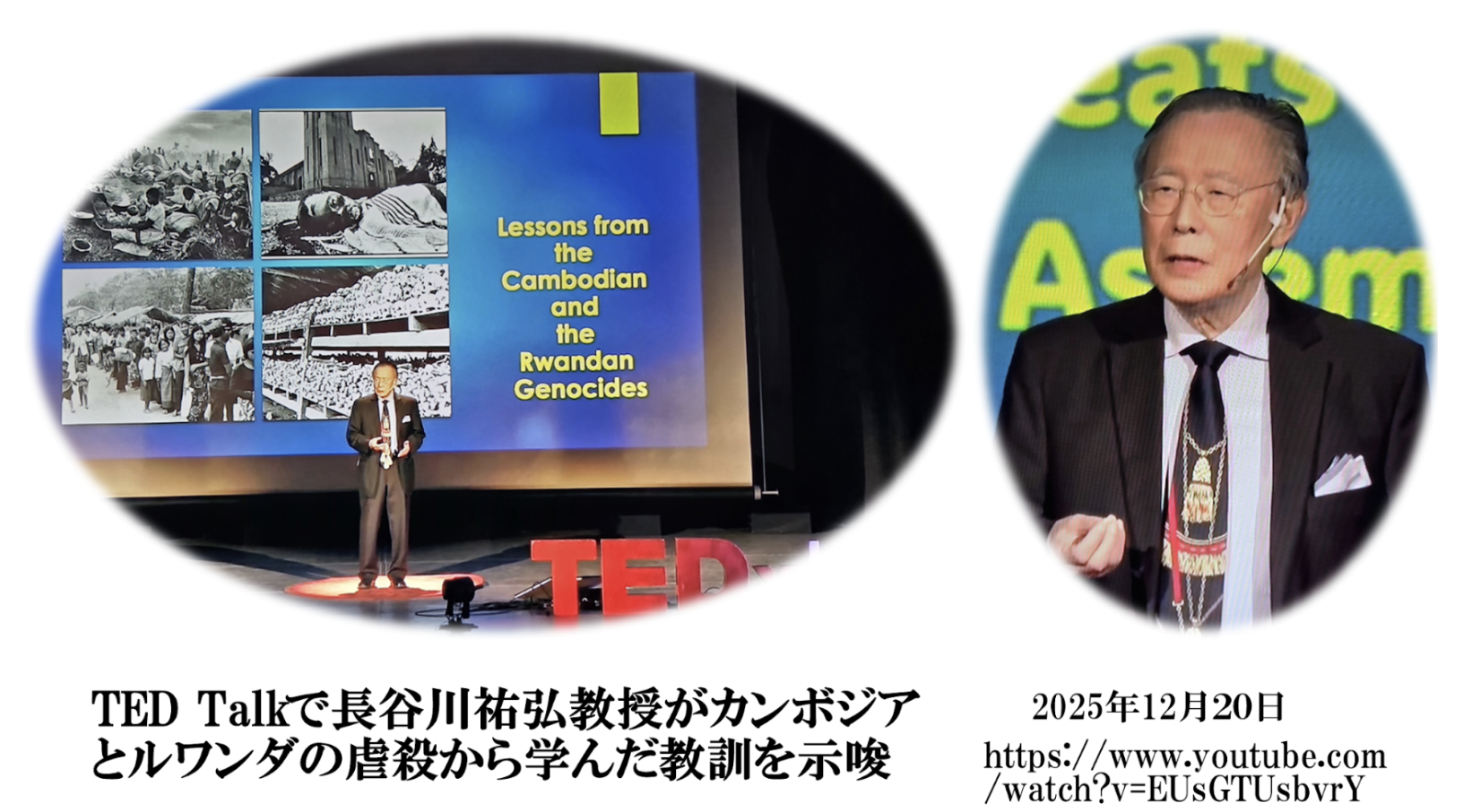
In his TED Talk, Professor Sukehiro Hasegawa argued that the chaotic state of today’s world is deeply rooted in the Westphalian mentality of state-centered sovereignty, or what he described as “We the States.” He emphasized that the international community must return to the spirit of “We the Peoples,” as enshrined in the opening words of the United Nations Charter, and transform itself into a truly people-centered global community.
Professor Hasegawa noted that despite rapid advances in science and technology, conflicts and humanitarian crises continue to erupt around the world. He argued that the current United Nations has not been able to effectively prevent such tragedies because of structural limitations within the UN system itself. In practice, he explained, the UN remains largely an organization of states, vulnerable to the agendas and interests of a small number of powerful countries and their leaders. This structure has weakened people-centered international cooperation and made it difficult for the world to respond effectively to complex global challenges.
Drawing on his own experiences in conflict-affected areas such as Cambodia, Somalia, Rwanda, and East Timor, Professor Hasegawa stressed that under an international order dominated by state interests, the voices of people suffering on the ground are often not sufficiently reflected. Based on these experiences, he argued that the United Nations should evolve beyond a forum for negotiations among states and become a “United Nations by citizens,” where the voices of individuals are meaningfully represented.
Professor Hasegawa also referred to his unique analysis of Japan’s Meiji Restoration, suggesting that major institutional transformation requires the courage to imagine a future beyond existing frameworks. He stated that building a “new United Nations” will require a clear commitment to structural reform, as well as strong leadership capable of guiding the international community toward that vision.
In concluding his talk, Professor Hasegawa emphasized that the shift from “We the States” to “We the Peoples” is not merely a matter of institutional reform, but a transformation of the values that humanity must share. He called for an international order that places human dignity and security at its center, beyond the logic of state interests, and left the audience with a profound question about the future direction of the world.
Please watch the video here:
https://www.youtube.com/watch?v=EUsGTUsbvrY
(Reported by Koki IMON)