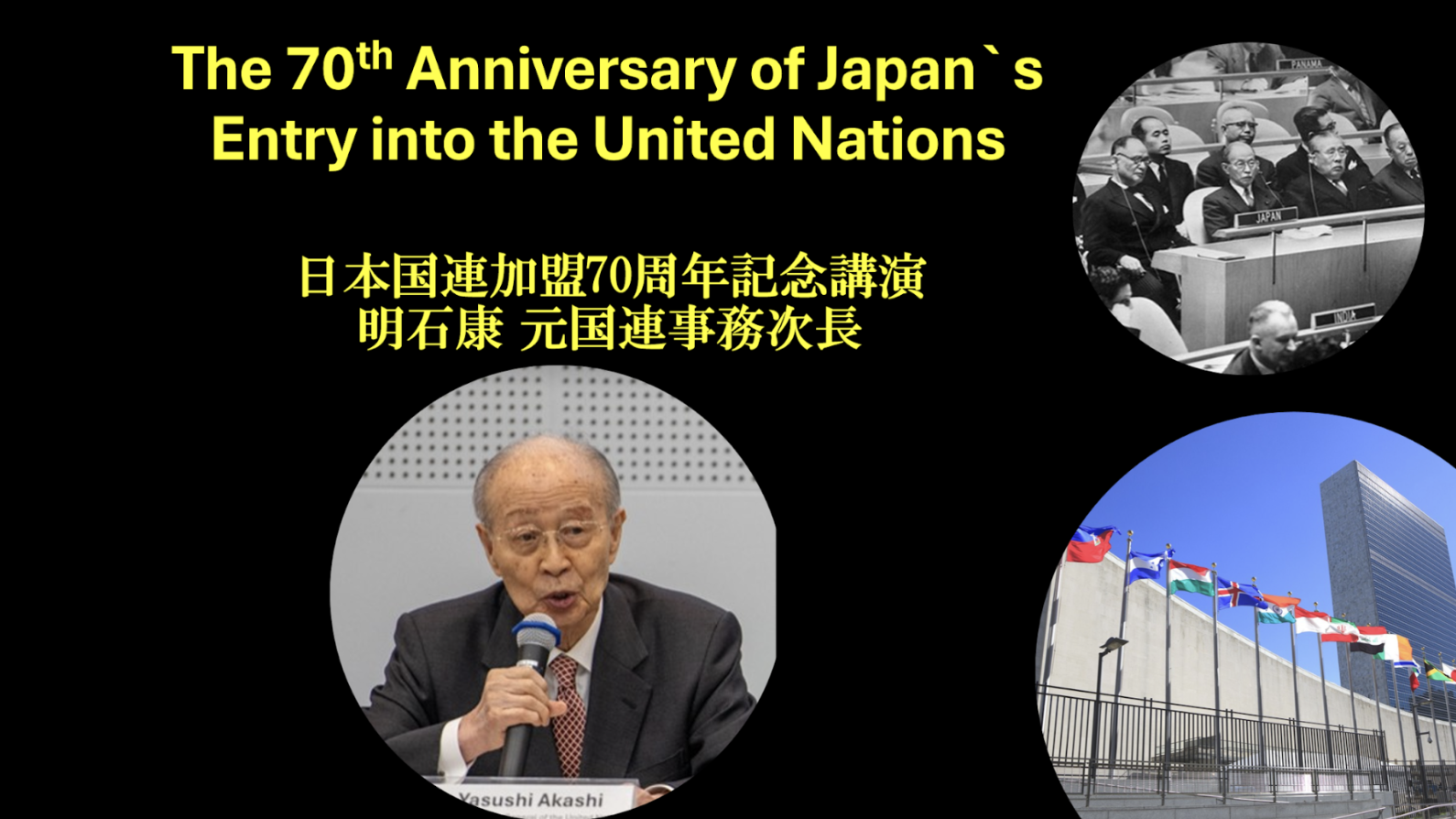
On April 15, 2026, a commemorative lecture marking the 70th anniversary of Japan’s membership in the United Nations was held at the United Nations University. Yasushi Akashi, President of the United Nations Association of Japan and former United Nations Under-Secretary-General, delivered the keynote lecture following opening remarks by Professor Tshilidzi Marwala, Rector of the United Nations University, and Mr. Takuma Sakaguchi, Director at the Ministry of Foreign Affairs of Japan.
In the discussion session that followed, participants, including former Ambassador Motohide Yoshikawa, former Ambassador Tadamichi Yamamoto, and Professor Kiichi Fujiwara, exchanged views on Japan’s contributions to the United Nations and the level of understanding of the UN among the Japanese public. The full text of President Akashi’s keynote lecture is provided below.
United Nations University and UN Association of Japan Symposium
“Eyewitness Account of Japan’s Entry to the United Nations”
Yasushi Akashi
Wednesday, 15 April 2026, 15:00 -17:00
Elizabeth Rose Conference Hall
United Nations University Headquarters
First of all, let me pay my warmest tribute to Dr. Marwala, the Rector of the United Nations University, for his dynamic leadership here in Tokyo. I know from my experience how the idea of the UNU was born and went through many discussions, three times by the UN General Assembly, twice by the Economic and Social Council, three times by the UNESCO Council, in addition to two expert bodies specially created within UNESCO and the United Nations. Rector Marwala has survived complex bureaucracy of all kinds, yet he has not lost any of his youthful energy or human warmth. As a great admirer of all his personal and intellectual qualities, I would like to express my deep gratitude to his dynamism to keep going and further strengthening this system.
Today, I beg him to allow me to speak about how Japan has become a UN Member State and keep this system going.
It was a freezing cold day in New York. It was December 18th 1956, a day Japan was formally admitted as the 80th Member State of the United Nations. Mr. Mamoru Shigemitsu, Foreign Minister of Japan, was just taking his seat at the front left of the great hall under the flashlight of the press, surrounded by several colleagues and ladies in gorgeous Japanese dresses.
President of the General Assembly, Prince Wan Waithayakon of Thailand, opened the meeting, stating that we now begin discussion of long time waiting which was co-sponsored by 51 member states. His motion was immediately adopted.
Prince Wan stated that he was delighted to welcome a great Asian country, Japan, which had developed its ancient culture into a modern industrialized nation. He certainly looked forward to Japan playing a very important role in the international community.
Among many customary greetings from the floor, I must say that two speeches were particularly outstanding. One was Krishna Menon representing India, notable for his piercing eyes and fiery speeches. He noted that all Asian and African countries were cosponsoring Japan’s admission. But he reminded that his country, India, did its best for Japan to win a generous peace treaty as early as possible, but India did not participate in the peace treaty with Japan, because there were unequal provisions. Menon said that Japan had left the League of Nations in 1933 and went through a dark period of international isolation and now stands on a historic point, and as the only country in the world to have suffered nuclear bombing, Japan evoked very deep sympathy of India. He prayed that Japan, which participated in the Bandung Conference just one year ago, would develop a close and organic relationship with neighboring countries.
Representing the United States, Henry Cabot Lodge’s speech was equally full of warm sympathy towards Japan. He mentioned that Japanese culture which was notable, among others, for classic dance, art, architecture, and poetry, has given much to humanity as a whole, and that his country, America, had very positive relationship with Japan in the process of its modernization. Lodge said that the United States was the mastermind of the San Fransico Peace Treaty, which restored Japan’s sovereignty, in which John Foster Dulles played a very major part after a clear abuse of Soviet vetoes which prevented the return of Japan to the international arena. Lodge was delighted that those dark days were over now, and he was sure that Japan would play a more constructive role for strengthening the United Nations and for resolving conflicts. From Lodge’s speech, it was very clear that the United States had an extremely close relationship with Japan from the end of the Second World War until the Peace Treaty had just been concluded.
X X X X X
Although I have listened to many other speeches by Japanese diplomats, Foreign Minister Mamoru Shigemitsu’s admission speech topped all of them. It was December 18th that Mr. Shigemitsu walked slowly towards the General Assembly’s green marble podium. His speech was not very long, and yet the speaker seemed to be getting tired. Its content clearly showed post-war Japan’s firm resolve and higher thinking in returning to the international community. Mr. Shigemitsu’s speech moved the audience, because it represented post-war Japan’s high spirit. Facing the UN audience, Mr. Shigemitsu stated post-war Japan’s very high desire for peace, rooted in the bitter defeat in the war, which had brought very hard experiences and much suffering to the Japanese people, who were looking for new international relations, replacing Japan’s old nationalism as well as militarism.
Even though Mr. Shigemitsu’s tone was less than perfect, it was clear that he took great delight in expressing his belief in the new existence of Japan at the United Nations, whose Charter now became Japan’s new source of existence. He expressed his conviction that the United Nations was the only choice for the Japanese people, who had abandoned war as well as the use of force.
Foreign Minister Shigemitsu emphasized that it is not a question of ideology but adoption of a realistic approach. He warned against extreme nationalism, which Japan used to believe from the time of the Manchurian War. Indeed, soon after its admission to the United Nations, Japan tried to assume the role of mediating between the Western group and the Asian-African group, and such co-sponsored plan passed unanimously at times but other times, did not succeed.
In fact, the road of Japan’s eventual membership in the United Nations in 1956 was a rather bumpy long road. For example, with the permission of its Parliament, Japan asked for the entry into the United Nations already in June 1952. And in the Security Council vote, Japan won the support of all other ten countries, but faced the opposition of one country, namely, the Soviet Union, which exercised its veto against Japan.
While Japan was experiencing several difficulties in the United Nasions, it won membership in some other organizations. For example, the International Court of Justice, the Economic Commission for Asia and the Far East (ECAFE), and ten other specialized agencies, seven of which already enabled Japan to join their Executive Boards.
The fact of the matter was that in 1953 because of the high hurdles existing under the UN Charter, as many as 21 countries had to wait outside the United Nations.
During this period, membership questions in the United Nations were in desperate situation because of the Cold War involving the United States and the Soviet Union. The United States blocked entry of countries friendly to the Soviet Union and the Soviet Union used its veto against countries favored by the United States.
From 1950 to 1955, not a single country was able to enter the United Nations. In 1953, twenty-one countries who wanted to join had to wait outside the United Nations while waiting for any decision by the Security Council.
But in 1955, the situation became different and the atmosphere changed. The Bandung Conference was held, and leaders of four major countries held talks in Geneva.
The international climate of opinion asking for an early solution to this UN membership issue was becoming rather active. As a result, opinions mounted to allow joining of 18 new countries, including Japan. Within Japan, both the lower and upper houses adopted resolutions favoring some solution. As to the UN General Assembly, it seemed to favor overwhelmingly 18 nations’ entry.
However, within the Security Council, the Nationalist Government of China opposed the entry of Mongolia, while the Soviet Union stated that it would oppose Japan’s entry as long as Mongolia was not admitted.
The end result of this controversy was that 16 of those countries, that was 16 of 18, were admitted to the United Nations, while Japan, along with Mongolia, had to remain outside.
Japan’s admission was finally achieved in December of the following year. This was the result of the Japanese government negotiating directly with the Soviet Union to resolve the issue for four and a half years, and according to Mr. Shigemitsu, “a long and anxious wait” was no exaggeration at all.
Japan’s new Constitution, stating in Article 9 that Japan renounce all armament and the right of belligerency, made many Japanese nationals feel that they had to rely on the United Nations in order to defend their country. It was natural that many Japanese political leaders had doubts regarding denial of self-defense in their Constitution.
Under their Constitution, many Japanese felt that peace, disarmament, and humanity were felt something extremely serious beyond normal political slogans. Under such circumstances, it was natural that political symbols such as” the United Nations” were much more readily accepted in Japan than in other countries.
First of all, major challenges to the United Nations took place in the Middle East where Israel, United Kingdom and Francee together invading Egypt. The United States, which condemned the use of force and the threat of its use, decided to attack these three powers. The United States decided on the application of the “Uniting for Peace” Resolution and thus an emergency special session of the General Assembly took place.
Thus, the UN Emergency Force was immediately established and took steps for the withdrawal of British, French and Israeli forces from Egypt. A great majority of UN member states rose with great speed. This action against illegal action by three powers was most courageous and dependable. The UN Secretary-General Dag Hammarskjöld and Canadian Foreign Minister Lester Pearson worked in close cooperation, and each was later awarded the Nobel Peace Prize.
Thus, maintenance of peace at Suez and its great success made people think that the future of the United Nations was now likely to be dominated by small and medium powers. Impatient countries already began to prepare for a UN standing force on the basis of the UN Emergency Force. It looked as if the United Nations had been infused with the glory and new hope.
However, at about the same time, in Hungary, there was a different event which showed many students and workers rose against the Soviet Unions’ attempt to intervene in their country and suppress a popular armed struggle. It was a symptom of de-Stalinization in Eastern Europe, which the Soviet Union tried its best to suppress. A visit to Hungary by the UN Secretary-General was refused.
A Special Committee on Hungary was established by the General Assembly, and made public, based on its own thorough research, that a rebellion rooted in a nationwide indignation was taking place.
The first assignment I was given at the UN Secretariat as a young political affairs officer was to work on the Secretary-General’s report on Hungary. I am sure that I will have another opportunity to talk about my acquaintance with Mr. William Jordan, Director of Political Affairs Division in the Department of Political and Security Council Affairs, going back to our acquaintance at the international student seminar in Minnesota in the summer of 1956.
Overall, Japan’s entry into the United Nations in December 1956 was dominated by a big wave of positive action for peace to resolve the Suez Crisis, in which the General Assembly generated peacekeeping action in the Middle East. In other words, the glorious accomplishment at Suez in the Middle East was brighter than the event confined to Hungary only.
When we look back on Japan’s second year at the United Nations, namely 1957, we find that Japan was extraordinarily active as a new member state, working closely behind the scenes with the Secretary-General Dag Hammarskjöld in Lebanon, where U.S. Marines were active. Japan also served as the Chairman of the UN Committee on Laos, reflecting the Secretary-General’s concern over domestic tranquility of Laos. Together with Brazil, Japan has also been one of most active non-permanent member states, successfully elected from regional groups.