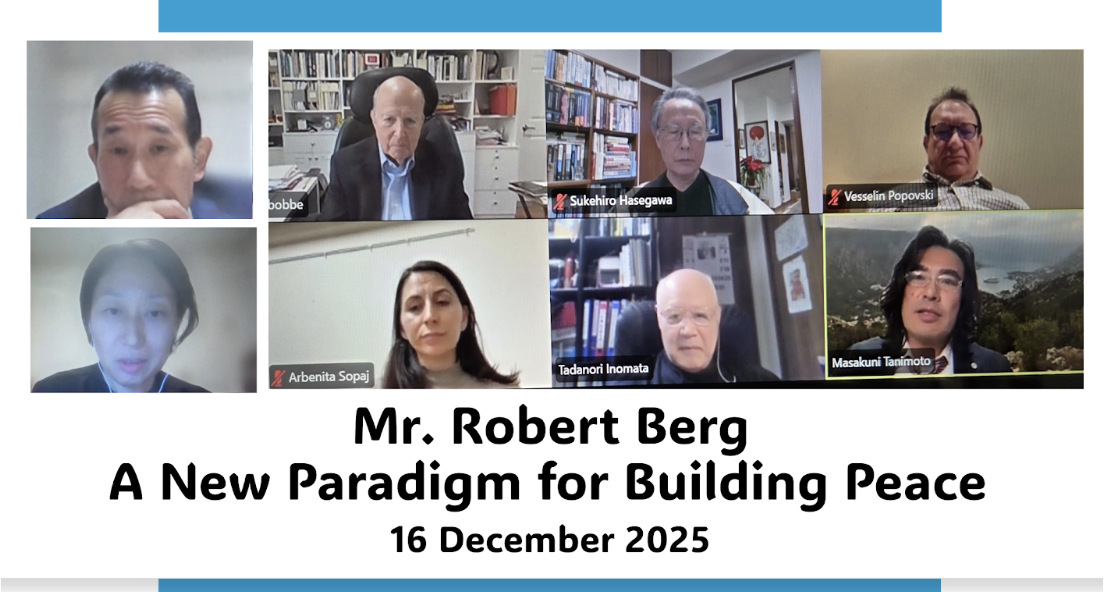
An online seminar on “A New Paradigm for Building Peace” was held on 16 December 2025 with the participation of scholars and practitioners.
The seminar opened with a presentation on the new paradigm by Mr. Robert Berg, Distinguished Fellow at the Stimson Center. Following his remarks, Ms. Maho Nakayama of the Sasakawa Peace Foundation shared her perspectives, highlighting the practical implications of the proposed framework for peacebuilding.
Subsequently, Professor Koji Sakane, Ambassador Tadanori Inomata, and Dr. Arbenita Sopaj delivered their comments, offering insights from academic, diplomatic, and policy-oriented viewpoints. Their contributions fostered a multifaceted discussion on future directions for peacebuilding under the new paradigm.
The seminar was opened and concluded by Mr. Masakuni Tanimoto, who provided both the opening and closing remarks.
(Reported by Koki IMON)
Summary of Discussion
Global Peace Fund Initiative
The meeting focused on a new paradigm for peacebuilding, presented by Mr. Robert Berg, who emphasized the need for national, holistic, and systemic strategies to strengthen national resilience and address complex peace challenges. Mr. Berg proposed the creation of a large fund staffed by global experts to provide technical assistance and longer-term institution building, with a focus on involving Global South and fostering partnerships with multilateral development banks. He outlined a process for developing fund programs, including understanding citizens’ security needs, identifying stakeholders, addressing macro policies, and creating doable finance. The next steps involve building an advisory board and board of trustees, conducting an independent study for implementation planning, and exploring ways to enhance the economic case for peacebuilding to compete with other philanthropic causes.
Challenges in Global Peacebuilding
The meeting focused on peacebuilding and mediation challenges, with Ms. Maho Nakayama highlighting the need for better coordination among donor agencies and emphasizing the importance of integrating women’s perspectives into high-level security and political decision-making. Professor Koji Sakane raised concerns about the prevalence of violence and humanitarian suffering in regions like Israel-Palestine, Russia-Ukraine, and Sudan, and expressed worry about the rise of populism and inward-looking trends that hinder global peace initiatives. Both speakers underscored the necessity of supporting political leaders and civil society efforts to promote peace in a world marked by increasing conflicts and a lack of strong political will for peace.
Peacebuilding Strategies and Challenges
The meeting focused on challenges and strategies, with discussions led by Ambassador Inomata and Mr. Bob Berg. They highlighted the importance of involving women in peace processes, referencing the 1325 anniversary and the need for a strong strategy involving women, as suggested by Noeleen Heyzer, former Executive Director of UNIFEM and also Executive Secretary of the UN Economic and Social Commission for Asia and the Pacific. The conversation also touched on the complexity of major conflicts and the fatigue in the humanitarian assistance field, emphasizing the need for a shift towards private finance. The group discussed the importance of learning from past peacebuilding successes, such as Colombia’s efforts, while acknowledging the limitations of peacebuilding tools once violence breaks out. They concluded that the fund should start with easier cases to build its capacity and reputation before tackling more complex situations.
Civilian Expertise in UN Peacekeeping
Ambassador Inomata pointed out the importance of civilian expertise in UN peace operations, highlighting 30 identified modules or models for peacekeeping and civil activities. He emphasized that peace is established at the community level and involves both security and development, noting that military forces alone cannot effectively manage peace operations. Ambassador Inomata expressed hope in harnessing the motivation of young experts to contribute to peacekeeping efforts and suggested developing coordination between peacekeeping and humanitarian assistance areas.
UN Reform and Peacebuilding Challenges
The meeting focused on the challenges and potential reforms within the United Nations, particularly concerning leadership, public relations, and the effectiveness of peacebuilding efforts. Mr. Bob Berg emphasized the need for better leadership and highlighted successful UN initiatives, while also suggesting that Japan could play a more significant role in peacebuilding. Professor Vesselin Popovski discussed the limitations of the UN in hostile environments and advocated for Security Council reform, including the removal of permanent memberships. Dr. Arbenita Sopaj inquired about the application of AI in peacekeeping and peacebuilding, to which Mr. Bob Berg responded with concerns about the dual-use nature of such technologies. The discussion concluded with an open invitation for Japan to consider its future role in UN peacebuilding initiatives.
UNPDA Proposal for Tokyo
At the end of the seminar, Moderator Sukehiro Hasegawa proposed establishing a new UN Peace Building and Development Agency (UNPDA) in Tokyo, combining UNDP and UN Peace Building Fund resources. The agency would focus on human security and include a tripartite partnership program managed by the UN in Nairobi, Kenya. His proposal aimed to address the need for a new approach in peacebuilding and development aimed at human security rather than state security.